
Morass started as a collision. The best part of letting your attention roam across unrelated fields is that, every so often, three of them turn out to be the same field. I had been circling one question in three different rooms of my head, and one afternoon I noticed the walls between the rooms were imaginary.
In the first room I was thinking about power, the way I always do after a disaster, when a place reorganizes itself and you get to watch who ends up holding what. I read that through Bourdieu and Foucault, and Foucault's microphysics of power, the idea that power is not a thing you seize once but a field that runs through everything and has to be exercised everywhere at once, has been lodged in my head for years like a splinter I never wanted out.
In the second room I was deep in national security law and policy, the long reading and the longer podcasts, thinking about stability and competition and how rarely either one resolves into a clean battle line. The hard truth there is that influence is malleable. A dictator and a revolutionary have the same problem: the ground they think they hold needs constant tending and constant attention, and it slips anyway, almost always, no matter how hard they press.
In the third room I was thinking about clustering algorithms, the unglamorous math of cutting a space into groups. Some methods force clean lines. Some insist every point belongs to exactly one cluster. Some let the regions bleed together until the boundary is frankly a guess. That was the seam. Power, competition, and clustering are the same problem wearing different clothes: all three are about where one side's claim gives way to another's, and all three keep teaching the same lesson, that the line is never where you assume, never still, and never clean.
I wanted to hand that over instead of explaining it, so I tried to fold it into a game, with one rule about rules: there could barely be any. An organic learning curve, simple at the surface the way Go is simple, nothing to study before you play. I love Go for exactly that. But its grid of fixed intersections has always felt like a cage to me, a lattice for someone who spends most of his time trying to rewrite the board. So I kept the calm and threw out the lattice. What is left, once you do, is a border.
Two ways to own a board
There are two traditions for territory in games, and each is half of the answer. The capture tradition (Go, Reversi) draws hard edges: a stone is yours or theirs, a group is alive or dead, the line is exact. The influence tradition (area control, most wargames) draws soft ones: you project strength outward and the map is shaded by who reaches where. The capture games are right that territory has to resolve, that at some point the count is unambiguous. The influence games are right that until then, a border is a balance of pressure, not a fence.
Morass holds both. After every move it reads the terrain and redraws the border as the place where your reach and your opponent's are equal, the waterline between two tides. While the game is live, that line is soft and it moves. When it stops moving, it resolves, and the larger share of ground takes the match. Soft until it isn't — that is the bog.
The name
It changed, so it is worth a note. It was Mire for a while, then Myre, until app-store reality settled it: the names I wanted were taken. Morass turned out to be the better word anyway. It is literally boundary ground, a bog where land and water stop being distinct, which is the exact gradient the game runs on. But it carries the other meaning too, the morass you are stuck in, the struggle that grows more tangled the longer you are inside it. Both are the game. You are holding a line in ground that will not hold still.
The terrain is not neutral
High ground reaches further. Clustered pins harden into a stronghold. A cliff bends the border around it, and open water carves out ground that nobody can hold. The map is not a stage the game happens on. It is a distribution of power, and most of the skill is reading where the land already favors you before you have spent a single pin. That is the part that feels like Go without being Go: you are not memorizing openings, you are learning to see an advantage that was sitting in the terrain the whole time.
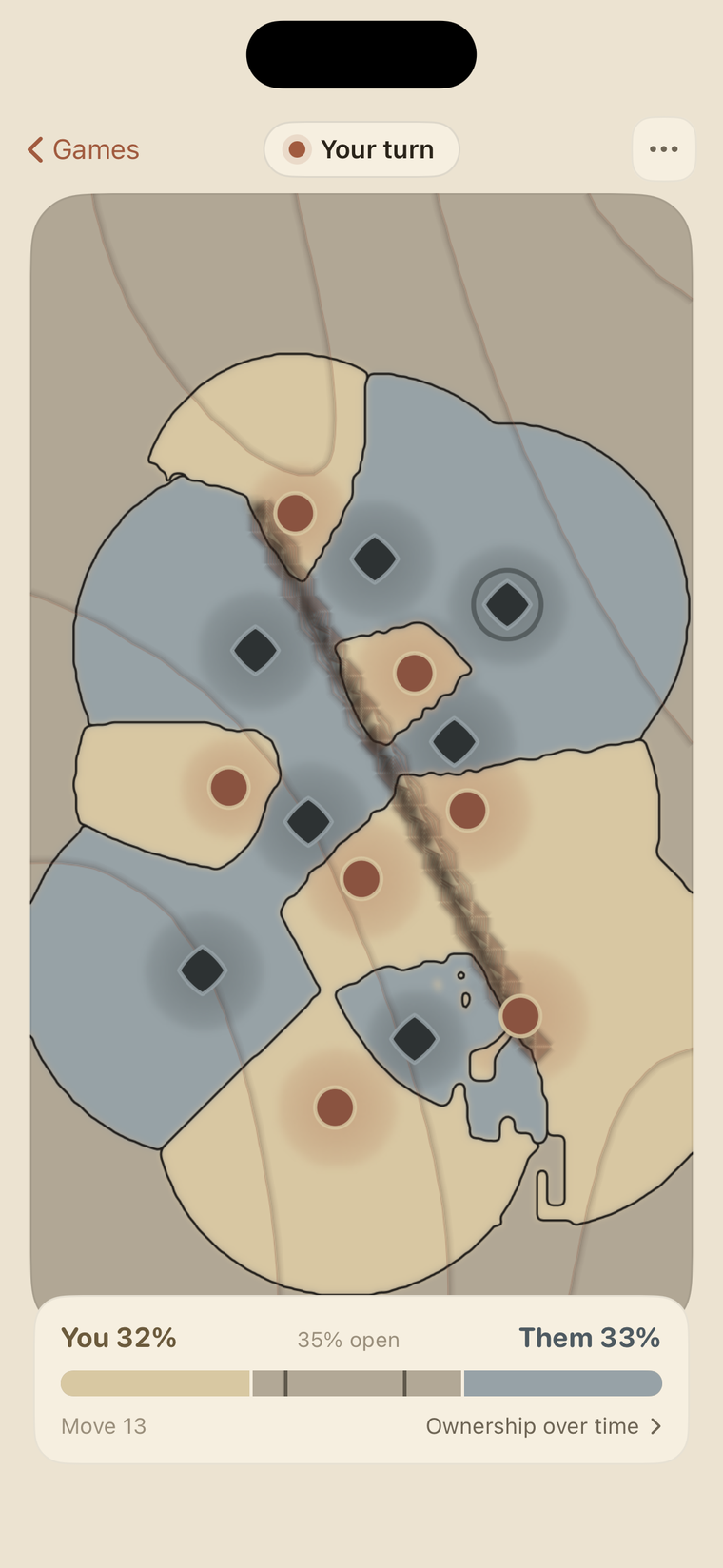
Under the board, the reading is done by a small four-layer neural network. Hand it the pins and the lay of the land and it returns the influence field: who reaches where, and where the border should fall between them. It is not a large model and it does not need to be. It only has to give the distribution of power the texture that real power has, lumpy and local and a little unfair, where a small move in the right place shifts the map far more than its size says it should.
Every game ends in a settle, and the settle is just a measurement. When the borders stop moving, you count the share of ground. There is a small chart that tracks ownership over the course of a match, the lead tightening and slipping, which is the closest the game comes to showing you its own arithmetic.
What I left out, and said so
Here is the uncomfortable part. Morass is a game about reading terrain at a glance, and I could not make that work honestly through VoiceOver or Voice Control. A board you understand spatially does not survive being read aloud one cell at a time. What comes through the screen reader is technically the state and none of the game. So I had two options: ship an accessibility feature that half-works and check the box, or leave it out and say plainly that I left it out.
I would rather lose the box than lie about it.
I left it out, and I wrote exactly that on the product page, in those words. The things Morass can do, it does: your pins and the opponent's are different shapes, not just different colors, and the interface respects Dynamic Type, dark mode, and Reduce Motion. The thing it cannot yet do, it does not pretend to do. The solo opponent gets the same honesty. It scales to your skill and stays beatable at the very top, which is a design choice and also an admission: I did not build a superhuman engine, and if I had, it would make a worse game.
And the deepest thing I left out is the one I most wanted in. Power is subtler than a four-layer network and a settling border, and I know it. Morass does not model power so much as gesture at it. I made my peace with that early, because the goal was never a simulation. It was a fun game that takes the complexity of power seriously enough to make you feel it, even where it cannot fully capture it.
Why calm
There are no timers, no streak guilt, no energy that refills while you sleep. Put it down for a week and it will be exactly where you left it, which is the only kind of patience I can reliably build into software. A morass is the ground where the line you are trying to draw will not hold still. Play a few rounds and you start to see your own line, the edge of what you can actually hold against what you only think you have. So where is yours? Morass is coming to iPhone, iPad, Mac, and Apple Watch...